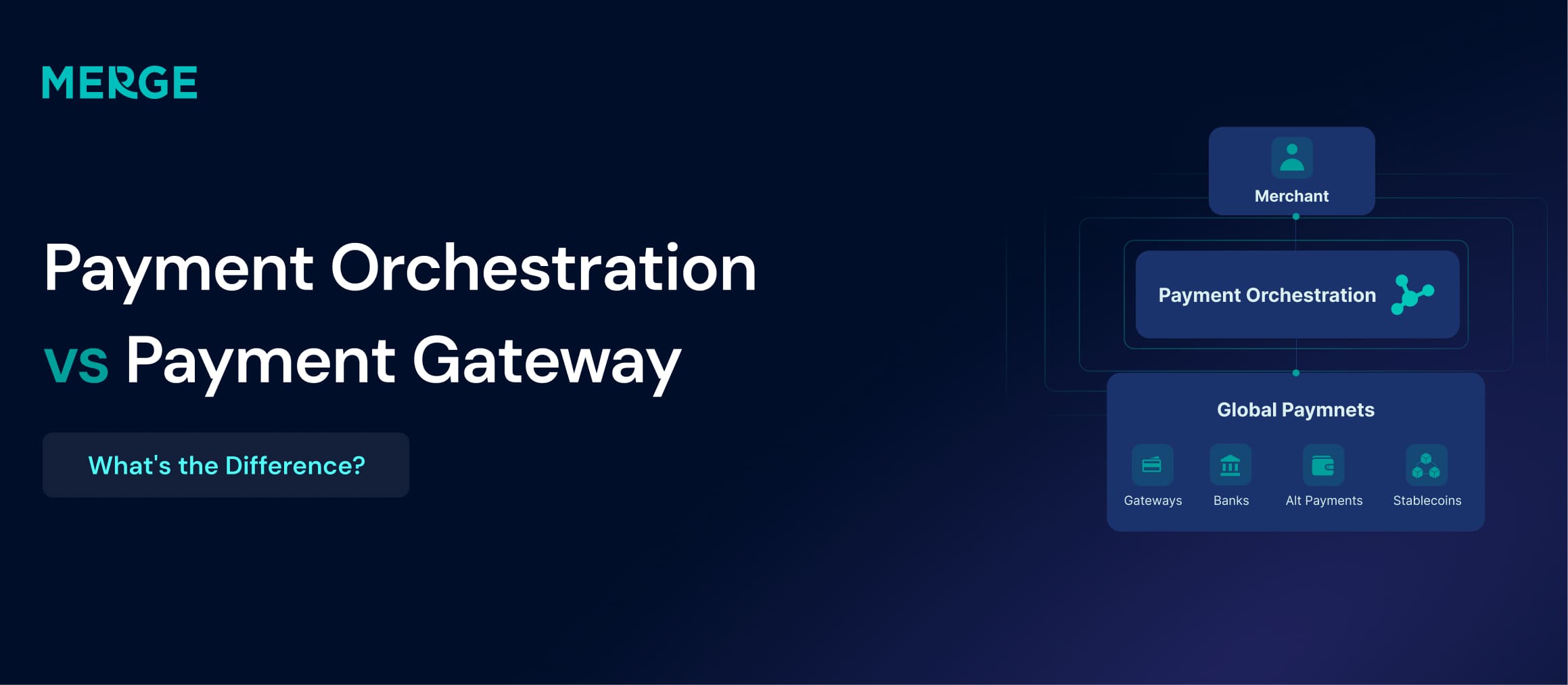


As businesses expand, their payment infrastructure often evolves from a basic gateway into a more sophisticated operation. A payment gateway authorises payments and passes transaction data securely between customers, merchants and banks. Payment orchestration, by contrast, is a control layer that unites multiple gateways and payment service providers under one API, enabling smarter routing, failover and reconciliation. Understanding the differences between these two models is essential for operators, fintech founders and treasury teams who must decide which model suits their needs today and tomorrow.
Payment gateways help businesses accept payments, while payment orchestration helps them run a payment operation. A gateway collects and encrypts payment details, then transmits them to an acquirer for authorisation. An orchestration platform centralises those gateways and providers, manages routing and retries, and produces unified reporting across markets. Businesses often start with a gateway, then adopt orchestration as their operations become more complex.
Note: Some payment service providers (PSPs) bundle gateway, acquiring, and basic routing functions in a single product. As transaction volumes and market complexity grow, dedicated orchestration platforms offer routing flexibility, provider redundancy, and analytics that bundled PSPs don't match.
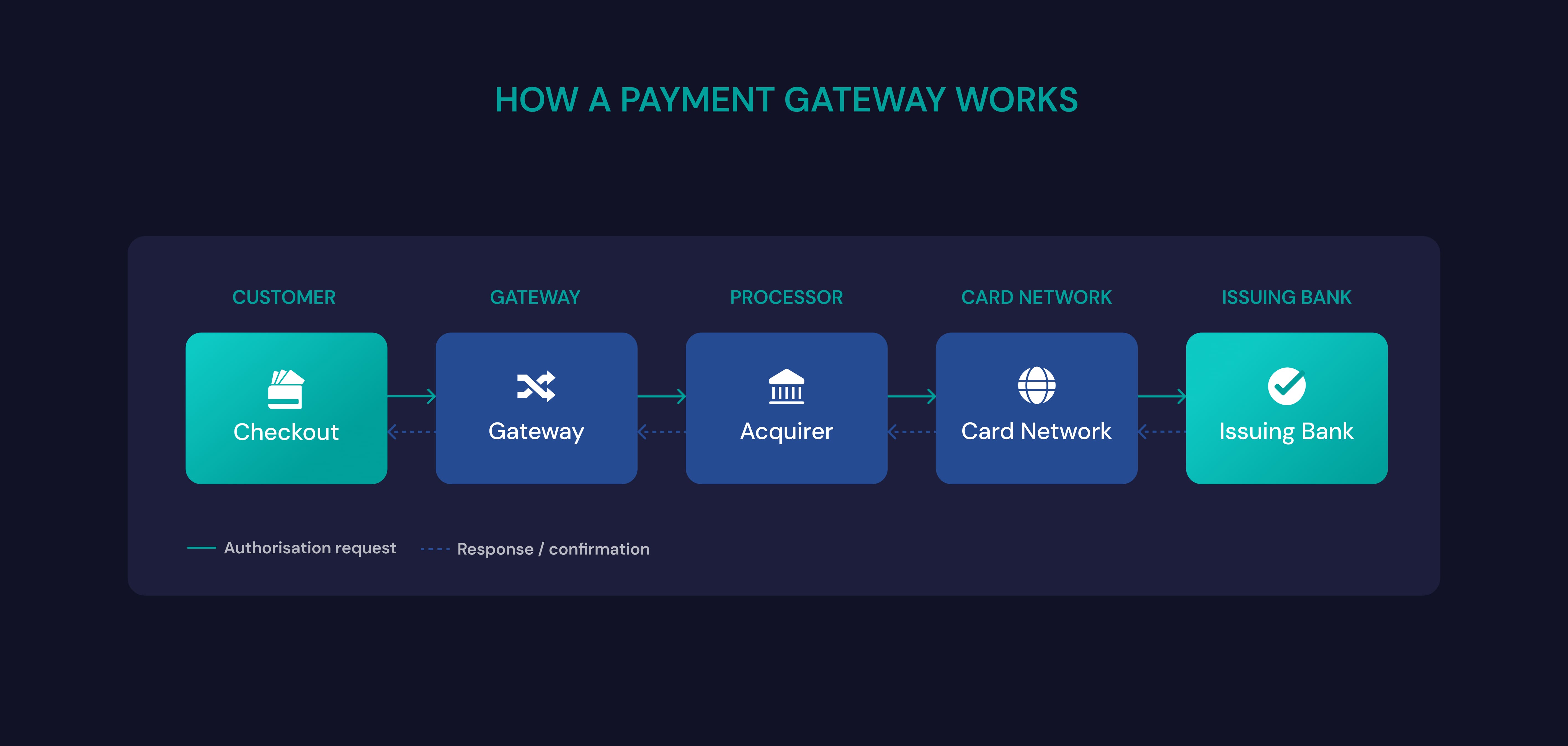
A payment gateway is the technology that enables businesses to accept electronic payments both online and in person. It acts as a bridge between a merchant’s website or point-of-sale system and the financial institutions that process transactions. Many modern payment gateway solutions handle this process by securely collecting, encrypting and transmitting customer payment data to the acquiring bank for verification. Once the issuing bank approves or declines the transaction, the gateway sends a confirmation back to the merchant, concluding the sale.
For businesses operating in specific regions, such as the United Kingdom, choosing the right UK payment gateway can also influence authorisation rates, supported payment methods and settlement efficiency.
Because gateways focus on authorising transactions, they are best suited to merchants with low to moderate transaction volumes and simple payment flows. They support a limited set of payment methods and currencies; adding new methods often requires integrating additional gateways or processors.
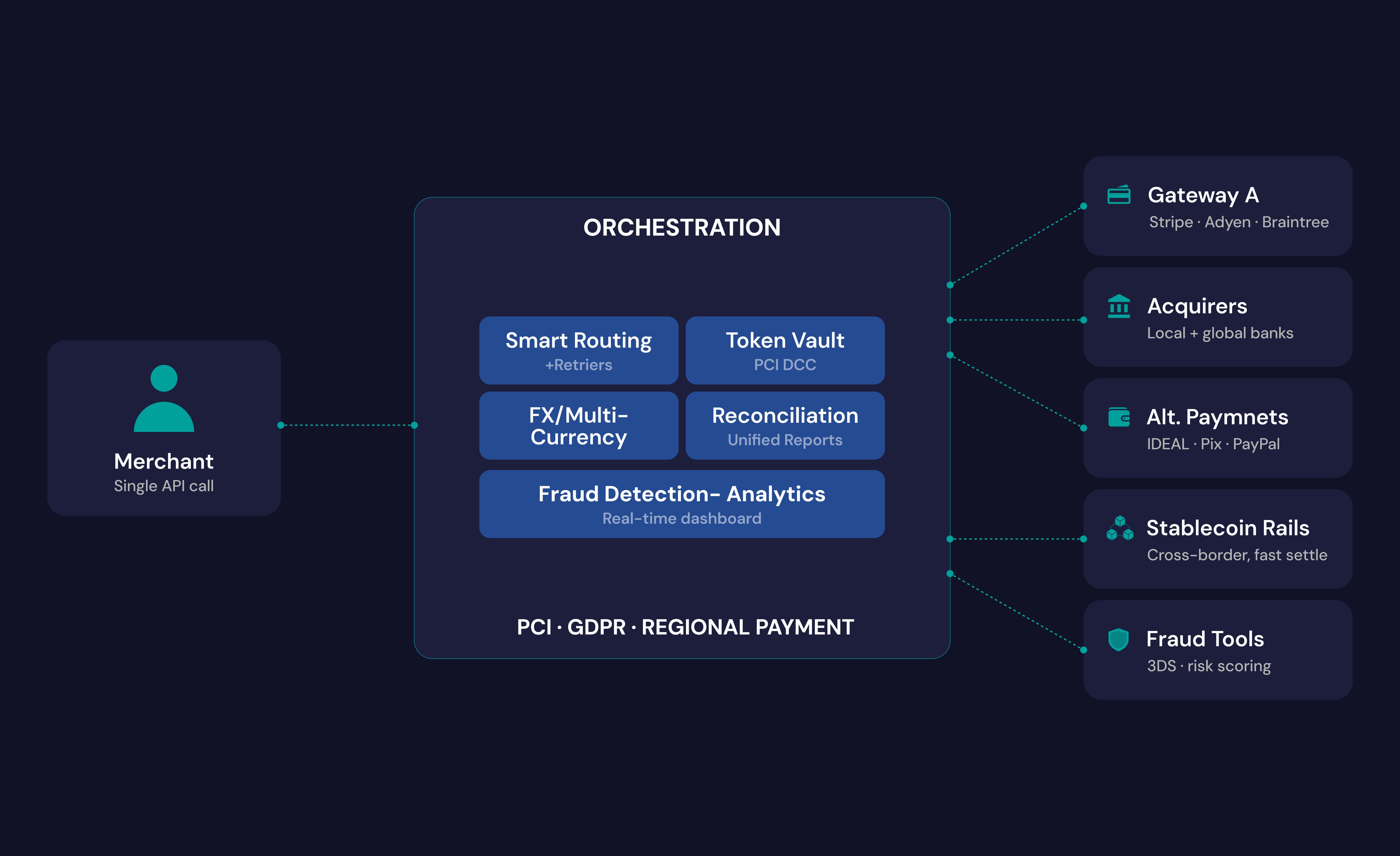
Payment orchestration is the process of centralising payment gateways, processors, acquirers and other financial service providers through a single platform. Rather than integrating and maintaining each provider separately, a business connects to an orchestration platform once and manages its entire payment stack from there. The platform then handles transaction routing, retries, tokenisation, fraud detection, multi-currency flows and reporting across all providers.
This model has become increasingly important for companies operating internationally, where global payment orchestration allows businesses to manage payments across multiple markets, currencies and local payment rails through one unified infrastructure. As a result, many fast-growing companies now evaluate the best payment orchestration platforms to improve approval rates, simplify integrations and gain greater control over their payment operations.
In practice, the difference between a payment orchestration platform and a payment gateway becomes clear when you look at how each handles providers, routing, reporting and global scale.
A gateway is focused on authorising individual transactions. It relays payment data between a merchant and a single acquiring bank. Payment orchestration platforms encompass one or more gateways and broaden the remit to include routing, retries, tokenisation, alternative payment methods and reconciliation.
Gateways require separate integrations for each acquirer or PSP. Merchants who operate in multiple markets may need to integrate and manage several gateways. In contrast, an orchestration platform offers a single integration that connects to numerous gateways, PSPs, fraud tools and alternative payment methods.
A gateway typically routes payments through a single path, offering limited fallback options. Orchestration engines evaluate transaction data and send payments through the provider most likely to approve the transaction, then retry with alternate providers when necessary.
With gateways, each provider produces its own reports, forcing merchants to consolidate data manually. Orchestration platforms normalise settlement data across providers, offering unified reporting and analytics.
Payment gateways may support only a limited set of currencies and payment methods. Scaling into new regions often requires integrating additional gateways. Orchestration platforms support local and alternative payment methods across regions, allow transactions in multiple currencies and handle foreign‑exchange conversions.
Gateways can serve small merchants effectively, but they become cumbersome for high‑volume businesses. Adding new regions or payment methods means additional integrations and increased maintenance. Payment orchestration platforms are built for scale: they enable rapid onboarding of new providers, flexible payment routing and unified data management without re‑engineering.
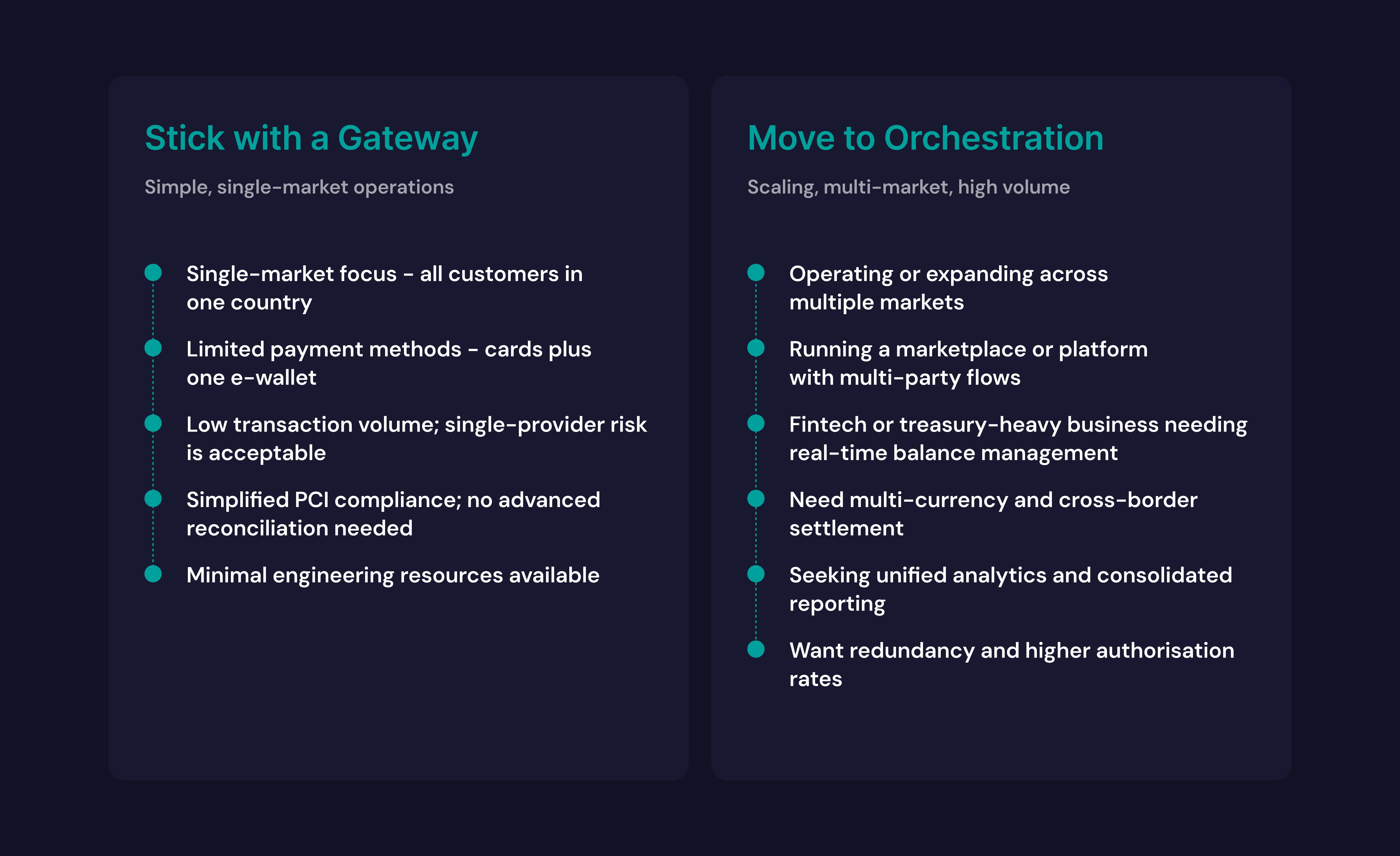
For small merchants operating in a single market with straightforward payment flows, a simple payment gateway may cover all needs. If you accept only a handful of payment methods and route all transactions through one acquirer, the overhead of an orchestration platform may not be justified. In these cases, choosing the best payment gateway for your region and customer base can be enough to support reliable payment acceptance. However, businesses that later expand across borders may eventually need to integrate international payment gateways to support local payment methods and currencies in different markets. Reasons to stick with a gateway include:
Minimal engineering resources – You prefer to avoid the complexity of managing multiple providers or building custom routing logic.
Businesses often outgrow a single gateway as they expand across markets, currencies and payment methods. At that stage, adopting a payments orchestration platform becomes the obvious next step, giving businesses the infrastructure needed to manage multiple providers, payment methods and currencies through a single integration. Payment orchestration becomes the obvious choice when you:
Want unified data and analytics – Consolidated reporting across providers allows you to analyse transaction trends, measure success rates and optimise your payment strategy.
Global businesses face challenges that go beyond simply accepting payments. They must navigate local payment rails, multiple currencies, regulatory compliance, fragmentation among providers, and the burden of reconciliation. A payment gateway solves the problem of accepting a card payment; it does not solve the operational challenges of running a payment operation across borders.
Payment orchestration platforms help by:
Complying with regional regulations – They incorporate built‑in tools for PCI DSS, GDPR and regional payment regulations.
When deciding between a gateway and orchestration, evaluate your current operations and growth plans. Consider the following factors:
For many businesses, the answer isn’t “gateway or orchestration” but “both.” A gateway remains essential for authorising transactions; orchestration builds on that foundation to manage multiple gateways, optimise payments, and provide operational agility.
As an example of how modern orchestration platforms are evolving, here's how Merge, the company behind this article, approaches these challenges:
Traditional cross‑border payments rely on networks of correspondent banks, which introduce delays, costs and trapped cash. Merge utilises stablecoin rails to send funds from a sender’s bank account through an on‑ramp to stablecoins, across a blockchain network and off‑ramp to fiat at the destination. This five‑step process can complete transfers in seconds rather than days and avoids correspondent banking fees.
Merge offers fiat accounts in over forty currencies and stablecoin wallets for holding and converting between fiat and digital assets. Businesses can open multi‑currency accounts in 75+ countries without establishing a local entity. Local payment rails in more than 100 countries allow merchants to collect and disburse funds via bank transfers, instant payment schemes or card networks.
Merge automates reconciliation through virtual accounts, segregated sub‑accounts and maker‑checker permissions. This structure supports marketplaces and investment platforms that need to segregate client funds while maintaining compliance. API‑driven reporting gives finance teams real‑time insight into balances, settlement status and FX positions.
As a regulated platform, Merge safeguards client funds and adheres to strict compliance standards. Its stablecoin infrastructure is built on regulated partners and provides transparency over reserves. The platform’s API and webhook architecture integrates with existing back‑office systems, reducing manual intervention and streamlining operations.
By adopting Merge, businesses gain not only a payment orchestration platform but also a global treasury partner that combines stablecoin rails, multi‑currency accounts and intelligent reconciliation. This aligns with the narrative that payment acceptance is just the start; running an efficient payment operation across borders requires a higher‑order control layer.
Explore how Merge can simplify your global payment operations → Book a Demo
Disclaimer: This content is for informational purposes only and does not constitute financial, legal or regulatory advice. Businesses should seek independent professional guidance before implementing payment infrastructure or treasury solutions.

A payment gateway authorises and transmits individual transactions, acting as a secure bridge between the merchant, customer and acquiring bank. Payment orchestration platforms manage multiple gateways and providers, routing transactions intelligently, handling retries, reconciliation, reporting and compliance.
Yes. A gateway is required to authorise transactions, while orchestration adds optimisation and control across multiple providers. Together, they form a scalable, flexible payment stack.
No. While orchestration shines for high‑volume, multi‑market businesses, smaller merchants preparing for growth can benefit from a single integration that supports future expansion.
Yes. By routing transactions through the provider most likely to approve them and automatically retrying failed payments, orchestration platforms can increase authorisation rates by double‑digit percentages.
It is middleware that centralises payment gateways, processors, acquirers and other providers into a single API. It manages routing, retries, tokenisation, reconciliation, reporting and compliance.
Disclaimer: This content is intended for informational purposes only. It should not be considered financial, legal, or operational advice. Businesses should evaluate their own compliance, regulatory, and infrastructure requirements before implementing payment solutions.